How do I claim my credits after passing?
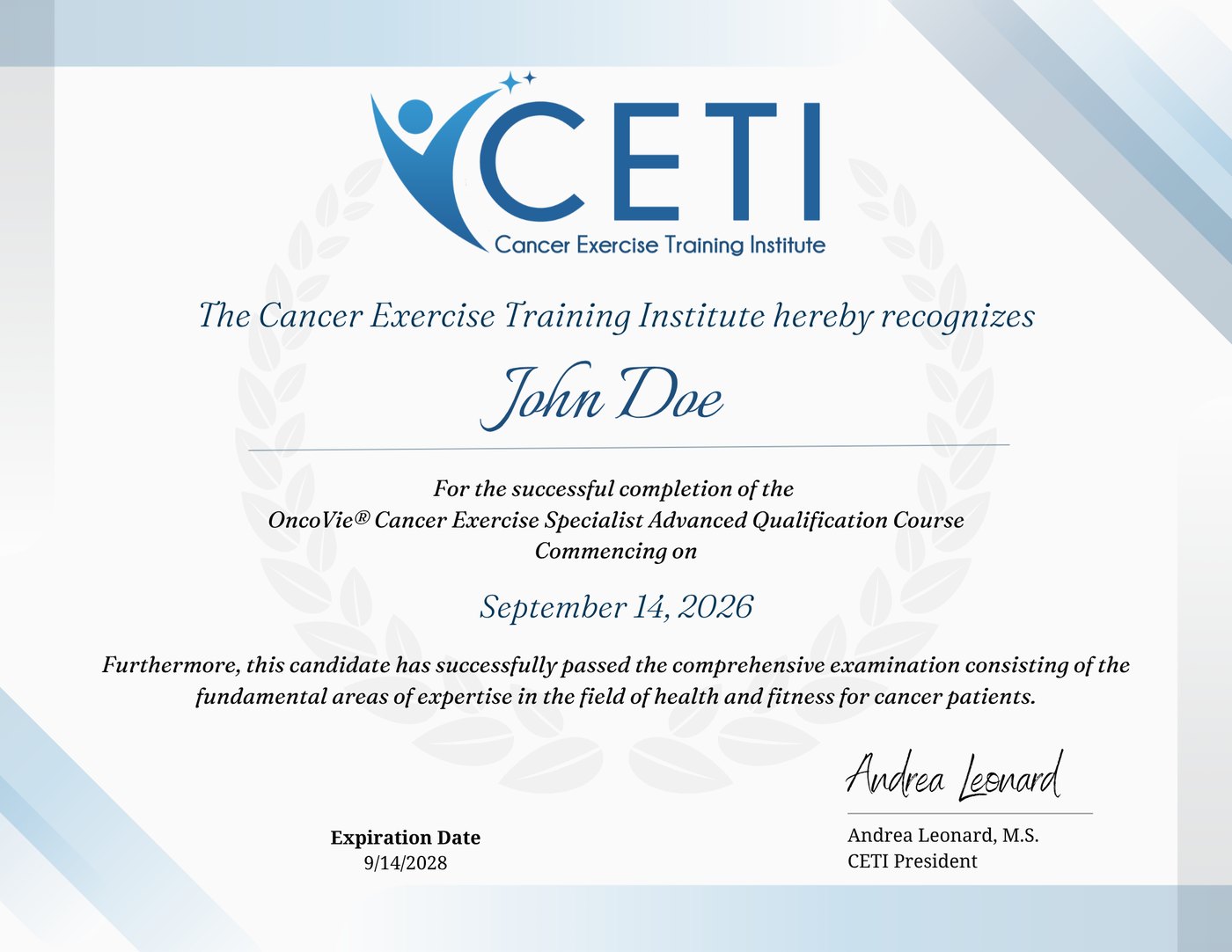
You’ll receive your Advanced Qualification certificate on passing the final exam with a score of 80% or higher. Your certificate carries the course number for each approving body — these are issued on completion, not before. Submit that certificate to your certifying body through their standard continuing education process. If they charge a petition fee for outside courses, send us the receipt and we’ll reimburse you up to $25.
My certifying body isn’t listed. Can I still claim credits?
Often, yes. Most bodies have a petition process for approved outside coursework, and CETI’s curriculum, contact hours and examination generally meet their requirements. Contact us and we’ll provide the documentation you need.
Do the credits differ by course?
Yes. The values above apply to the CES Advanced Qualification. CES–Pilates carries 40 NPCP CEUs, CES–Yoga carries 30 Yoga Alliance non-contact hours. The BOSU® Specialist carries 1.9 NASM CEUs. The Level 1 certificate carries no CEUs.
Who recognizes the qualification?
Nine continuing education organizations, listed above, award credits for completing it — and CETI has been a partner of the American Council on Exercise since 2019, one of the largest certifying bodies in the field. That approval is what makes the qualification count toward the credentials you already hold. It is approval rather than institutional accreditation, which is a separate process CETI has not sought.
How does recertification work?
The Advanced Qualification is valid for two years. Renewing gives you the current edition of the curriculum, including all updates to treatment protocols, research and exercise science since your last certification. You then sit a 50-question renewal examination on that current material, at the same 80% pass mark — so the credential certifies what you know now, not what you knew when you first qualified.
Do I need an existing certification to enroll?
No. A degree in a health or fitness field, relevant work experience, and an accredited fitness certification are all recommended, but none of them are required. The curriculum assumes a working knowledge of anatomy, exercise programming and client assessment, which is where that background helps.
If you want to go down this path without that experience, say so when you enroll — we provide additional educational support to get you to the point where the material lands. Nobody is turned away for not having started somewhere else first.